
Laser Measurements 101
Part 1: Why Measure the Frequency Change?
There’s a temptation to assume that lasers measure speed by measuring distance, and then just taking a derivative to get velocity. It’s a good intuition, and it shows you remember your calculus well:
$$v = \frac{dx}{dt }$$
But what about cases where the distance doesn’t change, even though there is velocity? Imagine a treadmill. From the observer, the treadmill never gets any further away, yet clearly it is moving. It has a velocity, but no change in distance with time. So how do we measure that velocity with a laser??
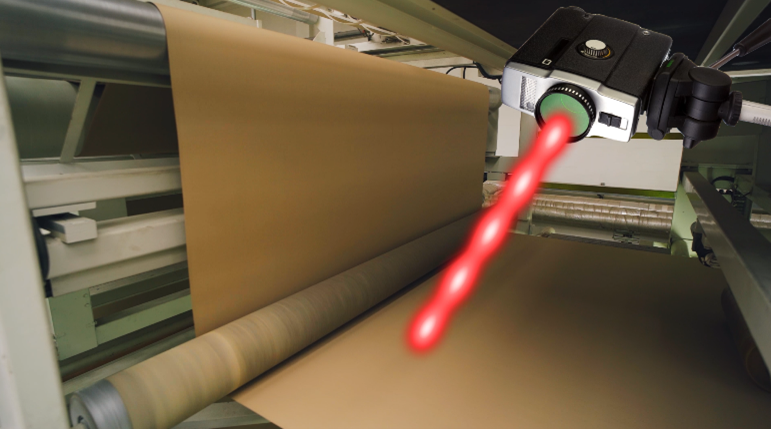
Welcome to laser velocimetry 101. It’s not a new field, it started in the 80s, but with recent advancements in laser manufacturing, especially VCSELs (thanks Apple), it has grown rapidly in the last decade! How does it work, though?
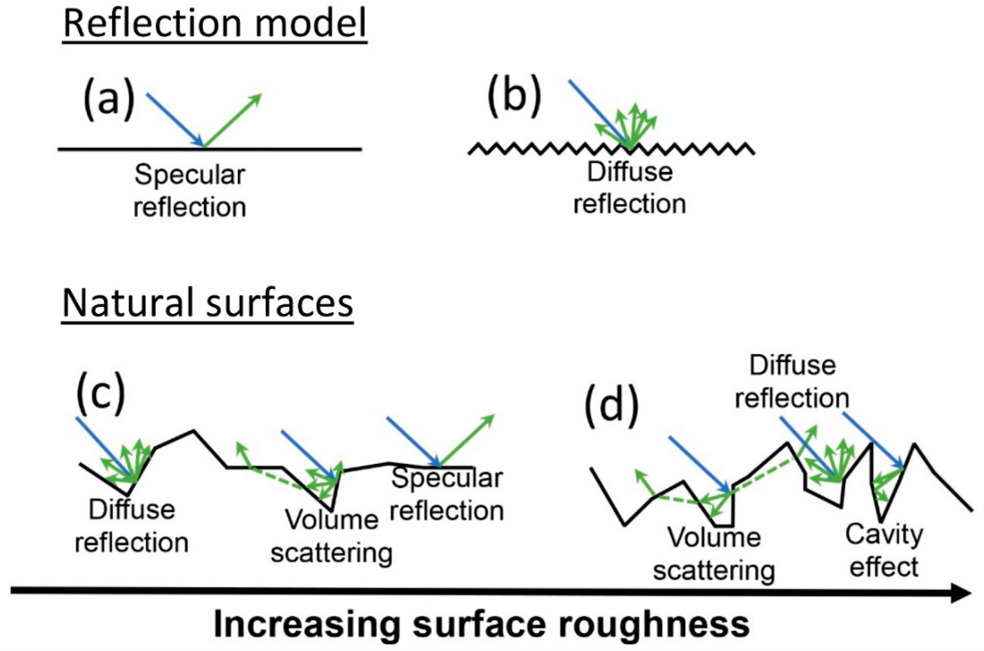
Light is a wave, (okay yes, it’s a particle too, but stop showing off. For our purposes, it’s a wave), so a laser is just a single sine wave moving through space. When that wave hits something it can reflect off of the surface, or enter the surface. For non-transparent objects, almost all the light will reflect. But where will it reflect to? Well, that depends on the roughness of the surface. If the surface is very rough it will “diffuse”, meaning spread out and scatter in many directions. If the surface is very smooth, if will reflect in a “specular” fashion, meaning bounce off cleanly. In fact, this is how a mirror works, and why any object appears reflective; it is smooth (relative to the wavelength of the light that hit it).
Why does this matter to us if we want to measure velocity? Well, it means that unless our treadmill is transparent (unlikely, though that would be cool!), we can rely on the laser light scattering off, and some of it reflecting back to precisely where it came from.
The meteorologists, military technicians, and police officers reading this have already realized why this is useful. The first person to realize this was useful was a man named Christian Doppler, who was trying to figure out why stars were often different colors. Why were some stars more blue, and some more red? His theory about why became: The Doppler Effect. Creative naming, I know.

The idea is that the observed speed of a wave depends on the speed of the observer. The classic example is the train horn, which is a higher pitch coming towards you, and lower away from you. In fact, you can hear it for almost any audible sound travelling more than ~20mph, including cars and planes too!
There are many different ways of mathematically expressing Christian’s insight, and for our purposes, the most useful is this:
$$f = (1+\frac{\Delta v}{c})f_0$$
Where: \(f \) is the observed frequency, \(f_0\) is the original frequency of the wave, \(c\) is the speed of light, and \(\Delta v\) is the difference between the velocity of the observer of the wave, and the transmitter of the wave. And actually, there’s a convenient trick, which is if we express the frequency as a wavelength, \(\lambda\), which is how lasers are specified, we can substitute:
$$ f_0 = \frac{c}{\lambda}$$
And that can be substituted in, which yields
$$ f=\frac{c}{\lambda} + \frac{\Delta v}{\lambda} = \frac{(c + \Delta v)}{\lambda} $$
Now we have an interesting solution, if we shoot a laser of known wavelength at any object that isn’t transparent or perfectly smooth (like, nanometer level smooth), we will get back that light at a slightly different frequency, depending on how fast the object is moving! This solves our treadmill problem very elegantly!
This is the reason I said meteorologists, cops, etc likely know where this is going already. They all use radar, and this is what radar does. It is in a much longer wavelength, so your eyes can’t see it, but it is the exact same principle used to measure a speeding car!
So, as an example, we want to use a red laser onto our treadmill moving at around 0.1 m/s and measure the precise speed using the frequency change. So we’ll use red light, 550nm wavelength is a nice choice, assuming the laser is stationary, then:
$$f=\frac{300e^6 + 0.1}{550e^{-9} }$$
Okay, so our red laser will be observed as a frequency of 545.4545456 THz. This is as compared to the 545.4545455 THz that the laser sent out originally!
Wait, just measuring the return frequency isn’t going to work, is it? For two reasons that I can think of…
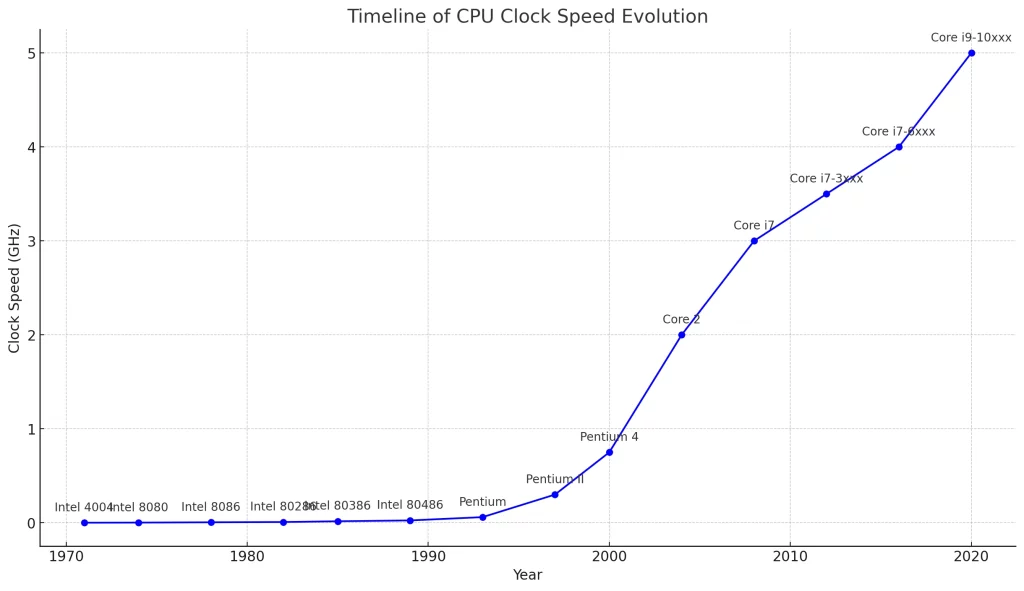
First, the computer-astute readers already know that measuring this fast is currently impossible. At current linear progress rates, if you assume no fundamental switching limit (a bold assumption), it would take ~10,000 years of progress before humans could run a CPU at this frequency.
The poor analog electrical engineers are quite upset reading this, as they’ve been forgotten about. “But wait!” they say, “we don’t need to use a computer to measure this, we’ll use an oscillator and downmix it to a more measurable frequency!”
This astute idea leads us to the 2nd, and even trickier problem. To measure a 0.1 m/s change, we see only a 0.0000003% change in the frequency. Of course for higher speeds the change is a larger percentage, but unless you are measuring spaceship velocities, it’s still quite a small change to measure. This is effectively a signal-to-noise ratio problem, which seems inconceivably difficult to solve.
We need to measure the frequency, which is hard enough, but we have to measure infinitesimally small changes. Even if we can achieve this, it all rests on the assumption that we know the original frequency we sent out to that same level of accuracy!
This doesn’t seem possible. So are we out of luck? Well, there’s one clever trick we can play which will get us back in the game. We can rearrange our doppler equation into this format:
$$ \Delta f = \frac{\Delta v}{c}f_0 = \frac{\Delta v}{\lambda} $$
All we have done is rearrange the equations, but now our 0.1 m/s yields a change in frequency of 181 kHz! That is super slow, a lower frequency than an AM radio! We can work with that!
The obvious question, of course, is how do we directly measure the difference in frequency, rather than just the individual broadcasted or reflected frequency? That will be the subject of Part 2!
If you can’t bear to wait for and read Part 2, you can skip ahead by watching the video on speed measurement below!